
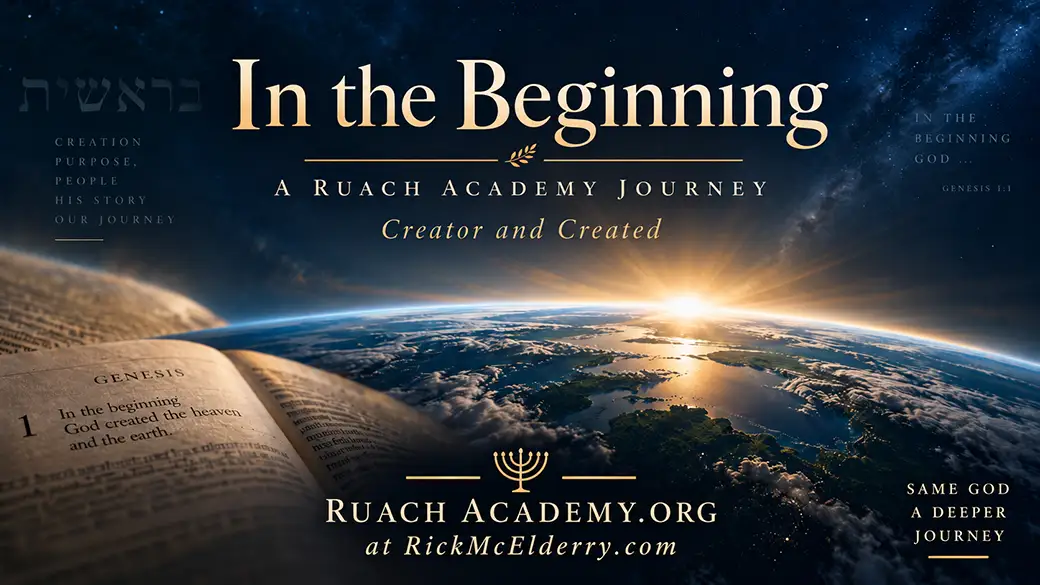
Before We Begin
This is not a lesson to complete. It is a journey.
My own journey toward the Creator has taken decades, and it continues today. Yours will have its own pace, questions, struggles, discoveries, and moments of awakening.
There is no deadline here. There is no grade. There is no expectation that you will arrive at the same conclusions I have, or arrive at them on my timetable.
I can share the road I have traveled. I can show you the Scriptures that caused me to question, search, change, and grow. But I cannot walk your journey for you.
Your relationship with the Creator must become your own.
In the Beginning — The Creator and the Created
“In the beginning Elohim created the heavens and the earth.”
Genesis 1:1
Before we can understand who we are, we must begin with who created us. Scripture does not begin with mankind, religion, government, or human tradition. It begins with Elohim.
The first truth in this journey is simple, but foundational: Elohim is the Creator, and we are the created. Everything else must begin there.
If Elohim is the Creator, then He has the authority to define what is true, what is good, what is holy, and what He requires of those He created.
The created does not define the Creator. The Creator defines the created.
This changes the posture of the journey. Instead of asking, “What do I want Elohim to be?” we begin asking, “Who has the Creator revealed Himself to be?”
That question is where reverence begins. It moves us away from creating a god in our own image and toward discovering the Creator as He has revealed Himself.
The Beginning of Knowledge
“The fear of Yahweh is the beginning of knowledge.”
Proverbs 1:7
The journey toward truth does not begin with intelligence, education, or religious knowledge. It begins with the fear of Yahweh — with recognizing His holiness, authority, power, and place as Creator.
Fear of Yahweh is not merely being afraid. It is coming to understand who stands before us: the One who gave us life, who sees beyond appearances, and whose truth does not change to fit our preferences.
Reverence changes the way we search. We stop approaching the Creator as though He must fit our expectations, and we begin approaching Him with humility, willing to listen, learn, and be corrected.
A sincere search for truth eventually becomes a personal request: “Yahweh, show me the truth — even if the truth changes me.”
Reverence of Elohim
o revere Elohim is to honor Him with holy awe, humility, trust, obedience, and sincere worship. Reverence is not merely fear of punishment. It is recognizing His greatness, holiness, authority, and mercy—and allowing that recognition to change the way we live.
If Elohim is truly the Creator and we are the created, then reverence is a natural response. We do not approach Him as equals, nor do we decide for ourselves what He should be. We approach Him willing to listen, learn, repent, obey, and be corrected.
What Scripture Teaches About Reverence
- Elohim is the Creator of all things. Creation displays His wisdom and majesty (Genesis 1–2; Jubilees 2:1–3).
- Human life is brief and accountable before Him. “Teach us to count our days, that we may gain a heart of wisdom” (Psalm 90:1–17).
- Reverence leads to obedience. The fear of Yahweh is connected with purity, wisdom, and turning away from presumptuous sin (Psalm 19:7–14).
- Reverence includes repentance. Manasseh humbles himself, confesses his sin, and asks for mercy (Prayer of Manasseh 10–15).
- Reverence rejects idols and injustice. Enoch instructs his children to serve Elohim alone, reject idols, and practice justice (2 Enoch 66:1–7).
- Reverence produces praise and trust. Those who fear Him call upon Him, trust Him, and praise His name (Psalm 91:1–16; Psalm 145:1–21).
Three Questions of Reverence
Who is Elohim?
The Creator and eternal King.
Who am I before Him?
A mortal human being created by Him and accountable for my actions.
How should I respond?
With worship, repentance, obedience, justice, humility, and trust.
Reverence is therefore more than something we say we possess. It should become visible in the way we think, speak, worship, treat others, and respond when Scripture corrects us
A Seven-Day Journey in Reverence
There is no requirement to complete this in seven consecutive days. Remember, this is a journey, not an assignment. Spend as much time with each reading as you need.
| Day | Reading | Meditation |
| 1 | Genesis 1-2 | Elohim created and ordered all things. What does creation teach me about His greatness? |
| 2 | Psalm 90 | Life is short, but Elohim is eternal. Ask Him for “a heart of wisdom.” |
| 3 | Psalm 19:7–14 | His instruction is pure and life-giving. What hidden or presumptuous sin needs correction? |
| 4 | Psalm 91 | Reverence includes trusting Elohim as refuge. Where do I need to surrender fear? |
| 5 | Prayer of Manasseh 10–15 | Confess honestly and seek mercy. Let repentance become an act of reverence. |
| 6 | 2 Enoch 66:1–7 | Walk before Elohim with humility, truth, patience, and justice. |
| 7 | Psalm 145:1–21 | End this portion of the journey with praise. Speak aloud several reasons Elohim is worthy of honor. |
A Simple Practice for the Journey
As you spend time with each passage:
- Read the passage slowly.
- Sit quietly for five minutes.
- Write down one truth you learned about Elohim.
- Identify one response required of you—obedience, repentance, gratitude, humility, or trust.
- Pray:
“Elohim, teach me to honor You with my heart, my words, and my actions.”
Do not make the goal simply to finish the readings.
Knowledge without reverence can become pride. Knowledge joined with reverence should lead to humility, obedience, repentance, justice, and a closer walk with Elohim.
Questions for the Journey
Who has defined the Creator for me — Scripture, tradition, culture, family, religion, or my own expectations?
Am I willing to let the Creator correct what I believe, even when that correction is uncomfortable?
What beliefs have I accepted simply because they were taught to me, rather than because I examined them for myself?
When I read Scripture, am I searching for truth — or only looking for confirmation of what I already believe?
Do not rush past these questions. Sit with them. Return to them. Let the answers come honestly, and let the Creator show you what may need to change.
Continue When You Are Ready
There is no need to hurry. Stay with this part of the journey for as long as you need. Return to these Scriptures and questions whenever necessary. Move forward only when you are ready to keep searching.
A Personal Reflection
Time can cause us to drift outside the boundaries of covenant, just as we see in the story of Zipporah and Moses. That is why this journey may serve as a review for some and a new beginning for those who have recently come to the faith.
No matter how long we have walked this path, it is good to return to the foundation, examine ourselves, and remember whom we serve.
You can never go wrong by obeying the Father’s commandments. His instructions are not a burden; they are the boundaries that help keep us within covenant and walking in obedience before Him.
For some, this journey will be a reminder. For others, it will be the beginning of an entirely new way of seeing Scripture. Wherever you are on that road, continue seeking, continue learning, and remain willing to be corrected by the Word.
Shabbat Shalom.
Continue Your Journey